
Sint Maarten is one of the very few places in the Caribbean — and arguably the world — where a foreign national can purchase real estate with no restrictions, no special permit, and full freehold ownership rights. No government approval. No nationality clauses. No caps on how many properties you can hold. That openness is part of what makes Sint Maarten real estate uniquely attractive for international buyers looking for a second home, a vacation rental investment, or a permanent Caribbean residence.
Still, buying property anywhere abroad involves steps that are easy to get wrong if you go in unprepared. This guide walks you through the entire Sint Maarten property purchase process — from your first property search to picking up the keys — so you know exactly what to expect.
Can Foreigners Own Property in Sint Maarten?
Yes — completely and without restriction on the Dutch side (Sint Maarten). As a constituent country of the Kingdom of the Netherlands, Sint Maarten operates under a legal system based on Dutch civil law, which grants equal property ownership rights to foreign nationals and local residents alike. There is no qualifying residency period, no investor visa requirement, and no cap on property values foreigners can purchase.
This is a meaningful distinction from several neighboring islands — some Caribbean destinations require government approval letters or restrict non-citizens from owning land outright. In Sint Maarten, you arrive, you find a property, you buy it. The process follows well-established Dutch notarial law, which gives buyers strong legal protections.
It is worth noting that freehold land is the most common form of ownership on the Dutch side. Some properties — particularly in gated communities and certain coastal areas — are held on long-lease (erfpacht) from the government or private landowners. Long-lease properties can still be purchased, but the terms of the lease matter significantly for resale value, so always clarify ownership type early in the process.
Step 1: Define Your Property Goals
Before searching listings, spend time clarifying what you actually want from a Sint Maarten property. The island offers a wide range of products — oceanfront villas, hillside homes with panoramic views, condos in gated resort communities, vacant land for custom builds, and commercial units near Philipsburg or Maho. Each serves a different purpose and carries different cost and management implications.
Key questions to answer before your search: Are you buying for personal use, long-term rental income, short-term vacation rental, or capital appreciation? What is your currency — USD, EUR, or another? Do you want a turnkey property or are you open to a renovation project? Do you want to be near beaches, nightlife, or quieter residential areas? How long do you plan to hold the asset?
Understanding your goals shapes everything: budget range, community preference, property type, and the right agent to work with. Island Dreams Realty covers the full spectrum of Sint Maarten real estate — you can browse all Sint Maarten properties for sale across every price tier, neighborhood, and property type directly on this site.
Step 2: Set Your Budget and Understand True Costs
Sticker price is not your total cost. Foreign buyers frequently underestimate the additional expenses involved in a Caribbean property purchase. In Sint Maarten, the standard additional costs on top of the agreed purchase price include:
- Transfer tax: Currently 4% of the purchase price on the Dutch side (payable by the buyer)
- Notary fees: Typically range from approximately 1–2% depending on transaction complexity
- Legal / due diligence fees: If you engage an independent attorney (recommended), budget for their review of the title, survey, and deed
- Real estate agent commission: Typically paid by the seller in Sint Maarten, but confirm this in writing early
- Survey costs: A land survey is advisable for vacant land and older properties
- Inspection costs: Structural and systems inspections are not universally required but are strongly advisable for older builds
- Utility connection and setup costs: Especially relevant if buying vacant land for construction
As a rough planning figure, budget an additional 6–8% above the purchase price to cover all transaction-related costs. If you plan to finance your purchase rather than buy with cash, the Sint Maarten mortgage calculator on this site can give you a monthly payment estimate to help frame your budget against local financing options.
Step 3: Choose the Right Sint Maarten Neighborhood
Sint Maarten is a small island — roughly 34 square kilometers on the Dutch side — but it packs in notable variety across its communities. Location will significantly impact your lifestyle, rental potential, and long-term value.
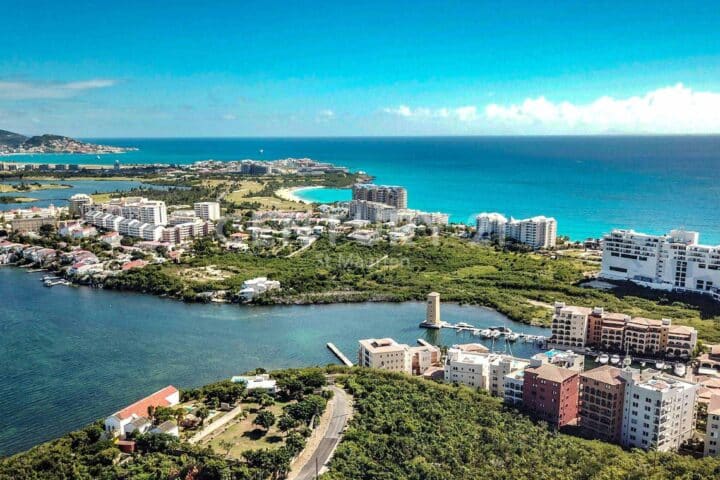
Simpson Bay & Maho
The most active and commercially dense area of the island. Close to the airport, marina, nightlife, restaurants, and casino. Ideal for vacation rental investment due to high tourist traffic. Not for buyers seeking quiet residential living.
Cupecoy
Upscale condo living with cliff-top views. Popular with international buyers. Known for its dramatic coastline, beach bars, and resort amenities. Strong short-term rental market.
Pelican Key & Beacon Hill
Premium residential and vacation villa territory. Pelican Key offers waterfront villas with direct beach or boat access. Beacon Hill is quieter with excellent ocean views.
Dawn Beach & Oyster Pond
On the eastern end of the island, bordering the French side. Dawn Beach is a sought-after stretch of white sand. Oyster Pond is a lagoon community popular with boaters and watersport enthusiasts.
Guana Bay & Indigo Bay
Gated and semi-gated hillside communities with stunning views over the Atlantic. Indigo Bay is one of the island’s most prestigious addresses, offering large lots and luxury villas with ocean panoramas.
Philipsburg
The Dutch capital, home to the cruise pier, duty-free shopping, and the commercial heart of Sint Maarten. More commercially active than residential, though there is property here suited for investment buyers.
Step 4: Work With a Licensed Sint Maarten Real Estate Agent
Sint Maarten has an established real estate market with licensed agents operating under standards aligned with NAGORES (the Netherlands Antilles Guild of Real Estate Specialists) and international bodies. Working with a licensed agent matters for several practical reasons: they have access to the full inventory of listed properties, they understand the pricing dynamics of each community, they can flag title issues early, and they manage the logistics of showings, offer negotiations, and communication with the notary.
Island Dreams Realty has represented buyers and sellers on the island since 2003. Our team brings decades of local market knowledge across every community and property type. If you’d like to meet the IDR team, explore the individual agent profiles to find the right fit for your purchase goals.
Step 5: Make an Offer and Negotiate
Once you identify a property you want to pursue, your agent will help you structure a written offer. In Sint Maarten, offers are typically made through a Letter of Intent or conditional purchase agreement (voorlopig koopcontract). This document outlines the agreed price, deposit amount, conditions (such as financing or inspection), and target closing date.
Negotiations in Sint Maarten real estate tend to be relatively straightforward. Most listed prices have some negotiating room, particularly for properties that have been on the market longer. Your agent’s market knowledge is valuable here — they will advise on what comparable properties have sold for and where there is genuine room to negotiate.
Once both parties sign the conditional agreement, the buyer typically pays a deposit of 10% of the agreed purchase price into an escrow account. This deposit is held until closing.
Step 6: Due Diligence — What to Check Before You Commit
This is the step that foreign buyers most commonly underestimate or rush. Do not skip it. Sint Maarten has a well-functioning land registry (Kadaster), and your notary is legally required to conduct a title search. However, buyers should also independently verify:
- Clean title: No outstanding liens, encumbrances, or ownership disputes
- Accurate land boundaries: Especially for hillside and beachfront properties where survey maps may be older
- Long-lease terms: If the property is on erfpacht land, review the lease duration, annual canon, and renewal conditions
- Outstanding utility bills and HOA fees: In some cases, unpaid fees become the responsibility of the new owner
- Zoning and building permits: Confirm all structures on the property have valid permits, particularly for extensions and pools
- Hurricane damage history and insurance: Sint Maarten was significantly impacted by Hurricane Irma in 2017; verify any post-Irma repairs and check that a quality insurer covers the property
If you are purchasing a condo within a homeowners association, request the HOA financial statements and meeting minutes for the past 2–3 years. This gives you visibility into the financial health of the complex and any upcoming major repair assessments.
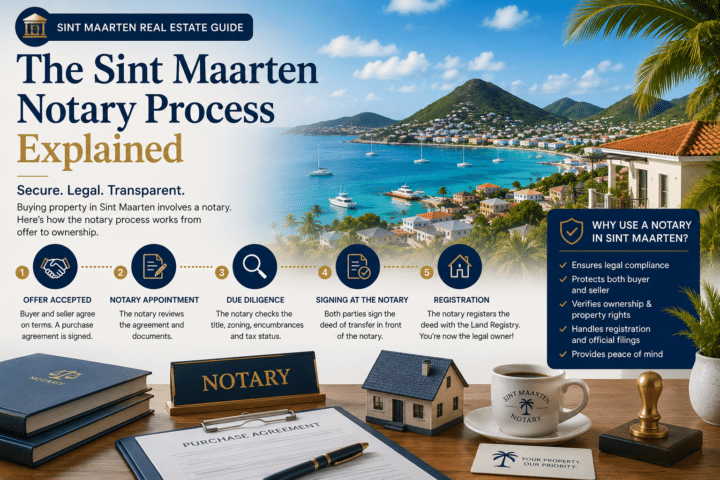
Step 7: The Notary Process — How Property Transfers Work in Sint Maarten
In Sint Maarten, all property transfers must be executed before a civil law notary (notaris). The notary is a neutral officer of the law — they represent neither buyer nor seller, but the transaction itself. Their role is to verify the title, draft the deed of transfer (akte van levering), ensure all taxes are settled, and register the transfer with the Land Registry.
Key steps in the notarial process:
- Notary drafts the provisional purchase agreement and reviews any conditions
- Notary conducts title search and confirms no encumbrances on the property
- Buyer arranges transfer of funds — either through a Sint Maarten bank account or international wire transfer
- On the closing date, both parties (or their authorized representatives via power of attorney) sign the deed before the notary
- Transfer tax is paid to the Tax Authority (Ontvanger) at or before closing
- Notary registers the transfer with the Kadaster (Land Registry), completing the legal transfer of ownership
For buyers who cannot be physically present on the island for closing, a power of attorney can be granted to a trusted representative — often the agent or attorney — to sign on your behalf. This is a common arrangement for international buyers.
Step 8: After Closing — What Happens Next?
Once the deed is registered and ownership is transferred, you will receive a certified copy of the deed from the notary. This is your formal proof of ownership. From this point, you are responsible for annual property taxes (which are relatively low in Sint Maarten by international standards), homeowner’s insurance, and any applicable HOA fees.
If you plan to rent the property — short-term vacation rental or long-term — you will want to register with the relevant authorities and potentially establish a local property management arrangement. Island Dreams Realty can provide guidance on rental management options and connect you with trusted local service providers.
Frequently Asked Questions: Buying Property in Sint Maarten as a Foreigner
Do I need to be a Dutch citizen or resident to buy property in Sint Maarten?
No. Sint Maarten places no nationality or residency requirements on property buyers. Any foreign individual can purchase real estate on the Dutch side without restriction.
What currency is used in Sint Maarten real estate transactions?
Most property is priced and transacted in US Dollars (USD). The Netherlands Antillean Guilder (ANG) is the official currency, but USD is widely used and accepted throughout the island.
Can I get a mortgage in Sint Maarten as a non-resident?
Local financing is available through Sint Maarten banks, but non-residents typically face stricter requirements, higher down payments (often 30–40%), and more limited loan-to-value ratios than residents. Many foreign buyers finance through their home country’s banking system using their Sint Maarten property as collateral. Use our Sint Maarten mortgage calculator to model different scenarios.
How long does a Sint Maarten property purchase take?
From accepted offer to closing, a straightforward cash purchase typically takes 4–8 weeks. Transactions involving financing, complex title issues, or out-of-country buyers coordinating documents can take 2–4 months.
Is Sint Maarten real estate a good investment in 2025?
Sint Maarten has seen strong recovery and market activity since the post-Irma rebuild period. Demand from European and North American buyers remains robust. The island’s tax environment, freehold ownership rights, and tourism fundamentals continue to support long-term value. That said, all real estate carries risk — work with a licensed agent and conduct thorough due diligence on any individual property.