
TL;DR: St Maarten real estate is open to foreign buyers, including US citizens, with no citizenship or residency requirement to purchase property on either the Dutch or French side of the island. Prices range from under $300,000 for inland condos to several million dollars for waterfront villas, and the buying process typically takes 60 to 90 days once a notary and attorney are engaged.
- Buy property as a foreigner without restriction on the Dutch side, since St Maarten imposes no citizenship or residency requirement on real estate purchasers.
- Compare Dutch side and French side rules carefully, because ownership structures, taxes, and notary processes differ even though the island is one landmass.
- Budget for closing costs of roughly 4% to 6% above the purchase price, covering transfer tax, notary fees, and registration on the Dutch side.
- Target waterfront and lagoon-front condos if rental income is the goal, since these units command the strongest short-term rental demand from tourists.
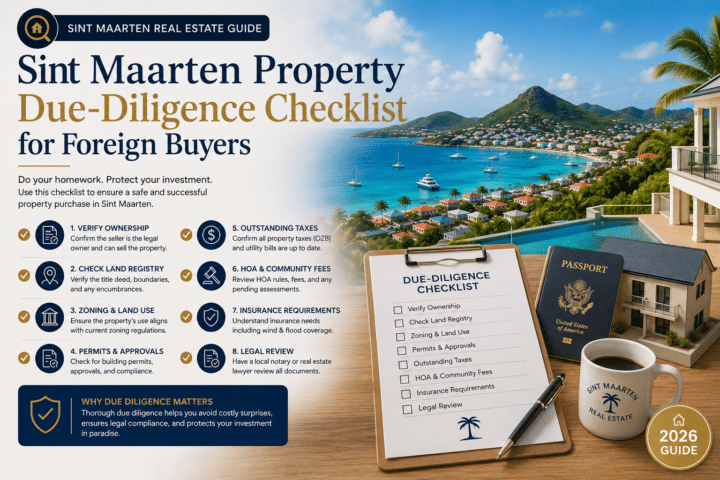
- Verify title and permits through a licensed notary before signing, since unresolved land disputes and unpermitted construction are common pitfalls on the island.
Understanding the St Maarten Real Estate Market in 2026
St Maarten real estate in 2026 remains a two country market split across one small island, with the Dutch side using US dollars and the French side using euros, and both sides drawing steady demand from North American and European buyers seeking vacation homes or rental income properties. Inventory is limited because the island is only about 34 square miles total, which keeps prices firm even during regional slowdowns.
Why Buyers Are Drawn to the Island
St Maarten combines a busy international airport, direct flights from major US and European hubs, and a dual identity as both a lively tourist destination and a quieter residential island depending on which side you choose. That accessibility is a major driver of real estate demand, since owners can fly in for a week or rent the property out when they are not using it.
The island’s tax environment also draws interest. The Dutch side has no capital gains tax on personal property sales in most cases, and neither side imposes the kind of wealth taxes common in parts of Europe, which appeals to investors comparing St Maarten against other Caribbean markets like the British Virgin Islands or Turks and Caicos.
- Direct flights. Princess Juliana International Airport connects to New York, Miami, Toronto, Paris, and Amsterdam.
- Rental demand. Cruise ship and stayover tourism keeps short-term rental occupancy strong in peak winter months.
- Dual currency access. Buyers can shop in USD on the Dutch side or EUR on the French side depending on financing preference.
Current Price Trends
Prices vary enormously by location and property condition, but general patterns hold across most listing platforms. Inland condos and older villas often list under $300,000, while waterfront and lagoon front properties routinely start above $500,000 and climb past $2 million for luxury villas in areas like Terres Basses or Beacon Hill.
Buyers searching for real cheap homes for sale in St Maarten under $300,000 will find the most options are inland condos, fixer upper villas, or land parcels rather than move in ready waterfront homes. Realistic budgeting matters here since listing prices on portals do not always reflect closing costs or renovation needs.
On St Maarten, the biggest real estate risk isn’t the price tag, it’s skipping the title search.
Can Foreigners Buy Property in St Maarten?
Yes, US citizens and other foreign nationals can buy property in St Maarten with no restrictions on ownership, and there is no requirement to hold residency or citizenship to purchase real estate on either the Dutch or French side. This makes the island one of the more accessible Caribbean markets for foreign buyers compared to destinations with strict local ownership laws.
Ownership Rules for US and Canadian Buyers
On the Dutch side, foreign buyers receive full freehold title to land and structures, transferred through a licensed civil law notary who registers the deed with the Land Registry. There is no local partner or corporate structure required, unlike some other Caribbean islands that mandate a local ownership stake for foreigners.
The French side operates under French property law, so buyers work with a notaire and the process mirrors buying property in mainland France, including a mandatory cooling off period after signing the initial sales agreement. Non-EU buyers, including Americans, can still buy freehold property here without special permits.
- No citizenship requirement. Foreigners can hold title in their own name on both sides of the island.
- No local partner needed. Unlike some Caribbean nations, St Maarten does not require a resident co-owner or corporate shell.
- Financing note. Local banks may require larger down payments from non-resident buyers, often 30% to 50%.
Does Buying Property Grant Residency?
Property ownership alone does not automatically grant residency or a path to citizenship on either side of the island. Buyers who want to live in St Maarten long term typically need to apply separately for a residence permit, and requirements differ between the Dutch and French administrations.
Many owners use their property purely as a vacation home or rental investment and visit under standard tourist entry rules, which allow stays of up to 90 days for most nationalities without a visa.
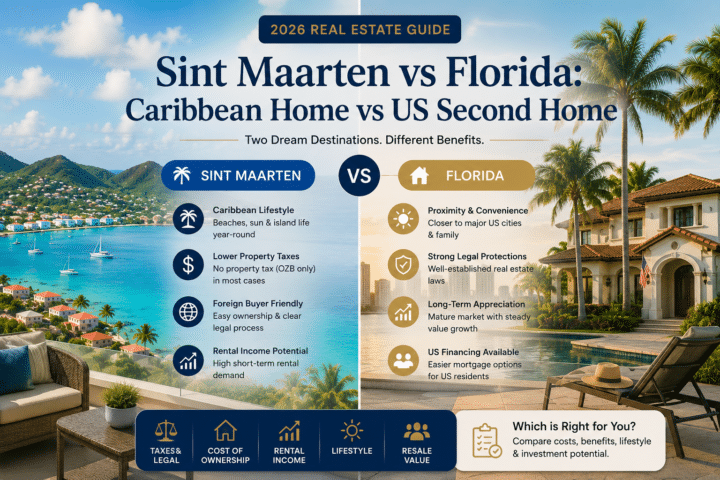
| Factor | Dutch Side (Sint Maarten) | French Side (Saint Martin) |
|---|---|---|
| Currency | US Dollar (USD) | Euro (EUR) |
| Foreign ownership | Freehold ownership open to all nationalities | Freehold ownership open to all nationalities, notary required |
| Transfer tax | Around 4% of purchase price | Around 7% to 8% of purchase price (registration fees included) |
| Property tax burden | Generally lower annual property tax | Higher annual taxe foncière in most cases |
| Typical buyer profile | US and Canadian buyers, rental investors | European buyers, especially French and Belgian nationals |
| Popular areas | Simpson Bay, Cupecoy, Pelican Key, Beacon Hill | Terres Basses, Orient Bay, Grand Case |
Dutch Side vs French Side: Which Should You Buy On?
The Dutch side, officially Sint Maarten, tends to suit buyers who want a more developed tourism infrastructure and USD based transactions, while the French side, Saint Martin, appeals to buyers who prefer a quieter atmosphere, French administrative systems, and euro denominated pricing. Both sides sit on the same 37 square mile island with no hard border, so many owners cross freely for shopping, dining, or beach access.
Choosing the Dutch Side
The Dutch side is home to Philipsburg, Simpson Bay, and Cupecoy, areas with casinos, a busier nightlife scene, and the island’s main airport and cruise port. Real estate here skews toward condos and villas built for the rental market, with strong demand from investors targeting vacation rental income.
Property taxes and transfer costs are generally lower on the Dutch side than the French side, and the purchase process is often faster since it does not carry the mandatory cooling off period required under French law.
- Best for. Rental investors and buyers wanting proximity to the airport, casinos, and cruise terminal.
- Popular neighborhoods. Simpson Bay, Cupecoy, Pelican Key, Beacon Hill, and Cole Bay.
- Currency. All transactions in US dollars, simplifying financing for American buyers.
Choosing the French Side
Saint Martin offers Orient Bay, Grand Case, and the gated communities of Terres Basses, known for quieter beaches, upscale dining, and stricter building regulations that preserve lower density development. Buyers who want a more European lifestyle, French administrative norms, and euro based pricing often gravitate here.
The French side also enforces the Loi Littoral, a coastal protection law that limits new construction near beaches, which has kept some areas from over developing but also constrains supply of new waterfront listings.
- Best for. Buyers seeking a European atmosphere, gated luxury communities, and lower building density.
- Popular neighborhoods. Terres Basses, Orient Bay, Grand Case, and Baie Nettle.
- Currency and tax. Euro transactions, with generally higher annual taxe foncière than the Dutch side’s property tax.

Types of Property and Price Ranges
St Maarten real estate spans four main categories: inland condos, waterfront or lagoon front condos, single family villas, and vacant land, with prices ranging from the low hundreds of thousands for a modest condo to multiple millions for a luxury waterfront villa. Rental yield potential and lifestyle preference usually drive which category a buyer targets.
Condos and Waterfront Units
Condos dominate listings for buyers searching under $300,000, particularly inland or garden view units in complexes around Cupecoy, Maho, and Simpson Bay. These units are popular with first time Caribbean buyers and those prioritizing lower maintenance over waterfront exposure.
Waterfront and lagoon front condos command a significant premium because they qualify for stronger short-term rental rates. Units directly on Simpson Bay Lagoon or Maho Beach often see the highest occupancy from tourists booking through vacation rental platforms, since walkability to beaches and nightlife drives demand.
- Entry level condos. Roughly $150,000 to $300,000 for inland or garden view units.
- Waterfront condos. Typically $400,000 to $1.2 million depending on size, view, and building amenities.
- HOA fees. Budget for monthly association fees that cover pool maintenance, security, and building insurance.
Villas and Land
Villas and Vacant Land
Single family villas range widely based on elevation, view, and proximity to the coast. Hillside villas with lagoon or ocean views in areas like Pelican Key or Beacon Hill often start around $600,000, while ultra luxury villas in Terres Basses or along Guana Bay can exceed $3 million.
Vacant land remains available on both sides for buyers who want to build custom, though buildable lots with clear title and utility access are limited and priced accordingly. Land near the coast on the French side faces the added restriction of the Loi Littoral, while Dutch side land is generally easier to develop.
- Mid range villas. $600,000 to $1.5 million for three to four bedroom homes with partial views.
- Luxury villas. $2 million and up for beachfront or clifftop properties with pools and staff quarters.
- Land parcels. Prices vary sharply by zoning, slope, and utility access, so a survey is essential before purchase.
The Buying Process Step by Step
Buying property in St Maarten follows a structured process centered on a licensed notary, and most transactions close within 60 to 90 days from signed offer to final registration. The process differs slightly between the Dutch and French sides but shares the same core stages: offer, due diligence, notary deed, and registration.
Step by Step on the Dutch Side
Buyers first make an offer through a licensed real estate agent, and once accepted, a preliminary purchase agreement is drafted. A civil law notary then conducts a title search, confirms there are no liens or unresolved boundary disputes, and prepares the final deed of transfer.
At closing, the buyer pays the purchase price plus transfer tax, roughly 4% on the Dutch side, along with notary fees. The notary registers the deed with the Land Registry, which finalizes the transfer of ownership.
- Engage a notary early. They handle title verification, tax calculation, and deed registration.
- Confirm zoning and permits. Verify any existing structures were built with proper government approval.
- Budget for total closing costs. Expect 4% to 6% above purchase price on the Dutch side.
Step by Step on the French Side
The French side process starts similarly with an offer and a preliminary contract called a compromis de vente, but French law requires a mandatory cooling off period, typically ten days, during which the buyer can withdraw without penalty. A notaire then conducts due diligence and prepares the acte de vente, the final deed.
Closing costs run higher on the French side, often 7% to 8% including registration fees and notaire charges. Non-resident buyers should also confirm how currency exchange and international wire transfers will be handled, since funds must clear before the notaire finalizes the sale.
- Respect the cooling off period. Buyers can legally withdraw within the statutory window after signing the preliminary contract.
- Work with a bilingual notaire. Many serve international clients and can explain documents in English.
- Plan for higher transfer costs. French side registration fees typically exceed Dutch side transfer tax.
Living Costs, Risks, and What to Avoid
St Maarten is moderately expensive to live in compared to mainland US or European costs, driven by imported goods, utilities, and insurance, but real estate related risks like unclear title, unpermitted construction, and hurricane exposure pose bigger long term concerns than day to day living costs. Buyers who skip due diligence on these fronts face the most costly mistakes on the island.
Cost of Living Considerations
Groceries, utilities, and imported building materials cost more than in the US mainland because nearly everything arrives by ship or air. Electricity costs in particular run higher than many US states, which matters for owners running air conditioning heavily in vacation rental units.
Property insurance, especially windstorm and flood coverage, is a significant recurring cost given the island’s hurricane exposure. Buyers should get insurance quotes before finalizing a purchase, since older or non-reinforced structures can be expensive or difficult to insure fully.
- Utilities. Electricity and water costs run higher than typical US mainland rates due to desalination and imported fuel.
- Insurance. Windstorm coverage is mandatory in practice given regular hurricane season exposure from June through November.
- Imported goods. Groceries and building materials carry import markups that raise both living and renovation costs.
Common Pitfalls to Avoid
The most frequent problems buyers encounter involve unclear title, boundary disputes, and construction done without proper permits, particularly on older properties or land that changed hands informally over generations. A thorough title search through a licensed notary is the single best protection against these issues.
Another common pitfall is underestimating hurricane recovery timelines and insurance claim complexity, especially after major storms like Hurricane Irma in 2017 exposed how slow rebuilding and claims processing can be on a small island with limited contractors and materials. Buyers should also avoid off market for sale by owner deals without independent legal representation, since skipping a notary or attorney review is the fastest way to inherit someone else’s legal problem.
- Skipping title search. Always verify clear title and boundary lines before signing any purchase agreement.
- Ignoring permits. Confirm past renovations or additions were properly permitted to avoid fines or demolition orders.
- Underinsuring. Get full windstorm and flood quotes before closing, not after.
- Going fully unrepresented. Even for sale by owner listings warrant an independent attorney or notary review.
Frequently Asked Questions
Can a US citizen buy a house in St Maarten?
Yes, US citizens can buy a house in St Maarten with no restrictions on foreign ownership, on both the Dutch side and the French side. There is no residency or citizenship requirement to hold title to property.
What to avoid in St Maarten when buying property?
Avoid skipping a formal title search, buying property with unpermitted construction, and closing a deal without a licensed notary or independent attorney reviewing the contract. These three issues cause the majority of buyer disputes on the island.
Is Sint Maarten expensive to live in?
Sint Maarten is moderately expensive to live in compared to mainland US costs, mainly because groceries, utilities, and building materials are imported. Housing costs vary widely depending on whether you buy inland or on the waterfront.
Can Americans live in Saint Martin long term?
Americans can visit Saint Martin under standard tourist entry rules for short stays, but living there long term requires applying separately for a residence permit through French administrative channels. Owning property does not by itself grant residency.
What is the difference between buying on the Dutch side versus the French side?
The Dutch side uses US dollars, has lower transfer taxes around 4%, and a faster closing process, while the French side uses euros, has higher closing costs around 7% to 8%, and includes a mandatory cooling off period after signing the preliminary contract.
Are there cheap homes for sale in St Maarten under $300,000?
Yes, inland condos and smaller garden view units on both sides of the island are frequently listed under $300,000, though waterfront and lagoon front properties almost always exceed that price range.
Do I need a real estate agent or can I buy for sale by owner in St Maarten?
You can buy for sale by owner in St Maarten, but you should still hire an independent notary or attorney to conduct due diligence, since skipping professional representation increases the risk of title or permit problems.
How long does it take to close on a property in St Maarten?
Most transactions close within 60 to 90 days from an accepted offer to final deed registration, though the French side takes slightly longer due to the mandatory cooling off period built into the process.
Making a Confident Move on St Maarten Real Estate
St Maarten real estate offers a rare combination for foreign buyers: unrestricted ownership rights, a choice between two distinct markets on one island, and property types ranging from budget friendly inland condos to multimillion dollar waterfront villas. The right side of the island for you depends on whether you prioritize USD transactions and rental income potential on the Dutch side, or a quieter European atmosphere and euro based pricing on the French side.
Whichever side you choose, the deciding factor in a smooth purchase is diligence, not just budget. Engage a licensed notary early, verify title and permits before signing anything, and get full insurance quotes before you close. Do that, and St Maarten’s real estate market can deliver a genuinely rewarding Caribbean property investment in 2026 and beyond.