
TL;DR
Yes, you can get a Sint Maarten mortgage, even as a foreign buyer, through local banks such as Windward Islands Bank, RBC Royal Bank, and Republic Bank. Plan for down payments of 20 to 30 percent for residents and 30 to 50 percent for non-residents, interest rates roughly in the 6 to 8 percent range, and terms up to 20 to 30 years. Financing is frequently arranged in US dollars. Strong income documentation and a local bank account make approval smoother.
Table of Contents
- Can Foreign Buyers Get a Mortgage in Sint Maarten?
- Which Banks Offer Sint Maarten Mortgages?
- How Much Down Payment Do You Need?
- Interest Rates, Terms, and Currency
- Documents and the Application Process
- Residents vs Non-Residents: What Changes
- Should You Finance Locally or Pay Cash?
Can Foreign Buyers Get a Mortgage in Sint Maarten?
Good news first: yes, you can. One of the things that makes Sint Maarten such a welcoming place to buy is that there are no restrictions stopping foreigners from owning property, and local banks do lend to international buyers. So if you have been wondering whether a Sint Maarten mortgage is even on the table for a non-resident, the answer is a warm and reassuring yes.
That said, we believe in honesty as much as enthusiasm, because trust is everything in a deal this size. Financing as a foreign buyer is absolutely possible, but the terms differ from what a local resident receives. You will generally need a larger down payment, you will need to document your income clearly, and the process moves at island pace, so a little patience goes a long way. None of that is a barrier; it is simply the lay of the land, and knowing it upfront keeps the whole experience smooth and even enjoyable. As you start your search on our buy page, it helps to understand financing in parallel, so your offer is realistic from day one.
Which Banks Offer Sint Maarten Mortgages?
Several established banks operate on the Dutch side and finance residential property. Each has its own criteria, appetite for non-resident lending, and product mix, so it pays to shop around rather than assume the first quote is the best one. The table below gives you a friendly starting map. Always confirm current terms directly with the bank, since rates and policies change.
| Bank | Notes for Buyers | Non-Resident Lending |
| Windward Islands Bank (WIB) | Long-established local bank, common first stop | Often considered |
| RBC Royal Bank | Regional Caribbean presence, familiar to North Americans | Often considered |
| Republic Bank | Broad Caribbean footprint, residential mortgages | Often considered |
| Banco di Caribe | Regional bank active in the Dutch Caribbean | Case by case |
| CIBC Caribbean | International banking group operating in the region | Case by case |
Think of this as a shortlist, not a ranking. The best fit depends on your residency status, income profile, and the property itself. A familiar regional name can feel comforting for North American buyers, while a local bank may know the specific neighborhood and property type better. We are happy to point you toward lenders who have worked well for buyers in similar situations, and you can always start the math early with our mortgage calculator to see what a given rate and term mean for your monthly payment.
How Much Down Payment Do You Need?
The down payment is usually the biggest planning item, so let us be clear and practical about it. Expect the requirement to scale with how connected you are to the island:
- Residents and locals: typically 20 to 30 percent down.
- Non-residents: commonly 30 to 50 percent down, depending on the bank and your financial profile.
Why the difference? From the bank’s perspective, a non-resident borrower is harder to assess and, if needed, to pursue, so the larger down payment offsets that risk. The upside for you is that a healthy down payment also means a smaller loan, lower monthly payments, and often a more flexible conversation with the lender.
A few related costs to budget alongside the deposit:
- Closing and transfer costs, including notary and transfer tax, which add a meaningful percentage on top of the price.
- Bank fees, such as appraisal and processing charges.
- Reserves, since banks like to see you have a cushion after closing.
Building a realistic total budget, not just the sticker price, is one of the kindest things you can do for your future self. We help every client map this out so there are no surprises at the closing table.
Interest Rates, Terms, and Currency
Here is what financing typically looks like once you are approved, with the friendly reminder that these are general ranges, not a quote.
Interest rates
Mortgage rates in Sint Maarten tend to sit somewhere in the 6 to 8 percent range, though your actual rate depends on the bank, your profile, the loan-to-value ratio, and whether the loan is in US dollars or local currency. Rates here are generally higher than what North American buyers may be used to at home, so factor that into your comparison.
Loan terms
Repayment terms commonly run up to 20 to 30 years, with the available length sometimes tied to your age and the property type. Shorter terms mean higher monthly payments but less interest over time, a trade-off worth modeling before you commit.
Currency
This is an important and reassuring detail for many buyers: while the official local currency is the Netherlands Antillean guilder, real estate is very often transacted and financed in US dollars, which the guilder is pegged to. That removes a lot of exchange-rate anxiety for American buyers and keeps the numbers familiar. Always confirm which currency your specific loan and payments will be in.
Documents and the Application Process
Banks here are thorough, and that is a feature, not a flaw, because it protects everyone. The smoother your paperwork, the smoother your approval. While each bank has its own checklist, you can generally expect to provide:
- Valid passport and identification.
- Proof of income, such as recent pay slips, employment letters, or, for the self-employed, business financials and tax returns.
- Bank statements, typically covering the past several months.
- A credit reference or report from your home country.
- Property documentation, including the sale agreement and appraisal.
- A local bank account, which many lenders prefer or require.
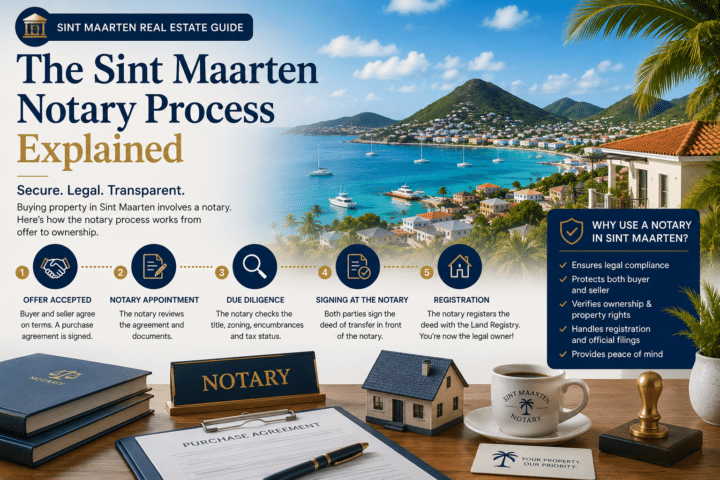
The typical flow looks like this: get pre-qualified, make an offer on a property, formally apply, let the bank appraise the home, receive your loan commitment, and then close with a local notary who handles the legal transfer. Start to finish, give it several weeks at minimum, and longer is not unusual. A little patience really is your friend here. If questions come up along the way, our FAQ answers many of the common ones, and you are always welcome to ask us directly.
Residents vs Non-Residents: What Changes
We touched on this, but it deserves its own clear summary because it shapes your whole plan. Being a resident of Sint Maarten generally unlocks friendlier terms.
As a non-resident, expect:
- A higher down payment, often 30 to 50 percent.
- More documentation and verification of foreign income.
- Slightly higher rates or stricter conditions in some cases.
- A preference, or requirement, for a local bank account.
As a resident, you typically enjoy:
- Lower down payment thresholds, often starting around 20 percent.
- A more straightforward income-verification process.
- Access to a wider range of products.
Many of our international clients eventually pursue residency, which can improve future financing and offers lifestyle benefits too. Whether you buy first or settle first, the path is very walkable with the right guidance, and plenty of happy owners have done exactly that, as you can read in our testimonials.
Should You Finance Locally or Pay Cash?
This is a genuinely personal decision, and there is no single right answer, only the right answer for you.
Local financing makes sense when you would rather keep your capital invested elsewhere, you want to preserve liquidity, or buying outright would stretch you thin. A Sint Maarten mortgage lets you own island property while keeping your money working at home.
Paying cash makes sense when you want a faster, simpler closing, the strongest possible negotiating position, and freedom from local interest rates that sit higher than mainland norms. Cash buyers often move quicker and with less friction.
Some buyers even blend the two, putting more down than the minimum to shrink the loan and the rate. There is no wrong choice, only the one that fits your finances and your peace of mind. We are always glad to talk it through with you honestly, with no pressure, because our reputation rests on you being happy years after the keys change hands.
FAQ: Sint Maarten Mortgages
Can a foreigner get a mortgage in Sint Maarten?
Yes. There are no restrictions on foreigners owning property, and local banks do finance non-resident buyers. You should expect a larger down payment, usually 30 to 50 percent, and more documentation than a resident would provide.
What down payment do I need for a Sint Maarten mortgage?
Residents typically put down 20 to 30 percent, while non-residents usually need 30 to 50 percent. A larger down payment also lowers your loan amount and monthly payments, which can strengthen your overall position with the bank.
What are mortgage interest rates like in Sint Maarten?
Rates generally fall in the 6 to 8 percent range, varying by bank, currency, and your financial profile. They tend to run higher than typical North American rates, so build that into your budget and compare offers from more than one lender.
Can I get a mortgage in US dollars?
Often, yes. Although the local currency is the guilder, which is pegged to the US dollar, real estate is frequently financed and transacted in US dollars, which keeps things familiar and reduces exchange-rate worry for American buyers.
How long does mortgage approval take?
Plan for several weeks at minimum, and sometimes longer, from application through appraisal to final commitment. Having your documents organized and a local bank account ready is the best way to keep the timeline moving smoothly.
Financing a home in paradise is more achievable than many buyers expect, and with the right preparation a Sint Maarten mortgage can be a comfortable, confident part of your purchase rather than a source of stress. The keys are realistic budgeting, organized paperwork, and a partner who tells you the truth at every step. When you are ready, run the numbers on our mortgage calculator, browse what is available on our buy page, and reach out through contact so we can guide you home.
Looking for your next home or investment? Browse the latest sint maarten real estate listings on Island Dreams Realty.